About Rebecca Carney - One Woman's Perspective

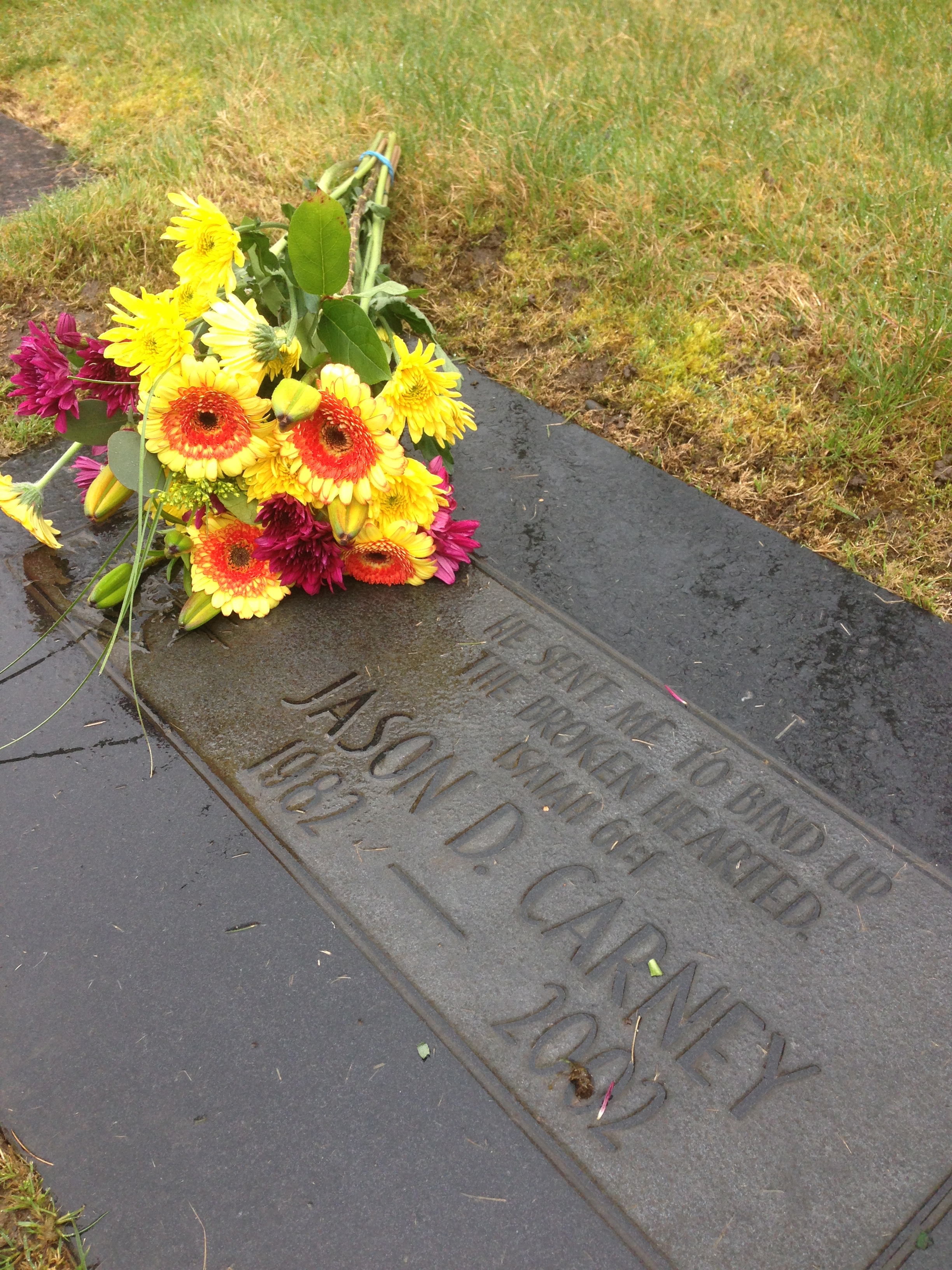
My name is Becky Carney. My husband, Joe, and I have been married for 36 years. We have two living children, Eric (33) and Jenna (28). We lost a baby in utero at 19 weeks in 1987. In 2002, our middle son, Jason (19), and his best friend, Alina (20), were broadsided by a drunk driver who was going at least twice the speed limit. They both died instantly. This blog is written from my perspective as a bereaved parent. I don't claim to know what it's like to walk in anyone else's shoes. Each situation is different; each person is different. Everyone handles grief differently. But if I can create any degree of understanding of what it's like to be a parent who has lost a child, then I have succeeded in my reason for writing this blog.

Vulnerability

The tragedy at the Boston Marathon really, really bothered me. Which, obviously, it should have. It was so awful, so senseless, so horrific. It made me mad, sad, full of grief for those affected, horrified, stupefied as to why anyone would do this to another person, and so many more emotions I can’t even describe. It brings tears to my eyes to think about it.

It wasn’t just that it makes me so dang mad that someone would hurt innocent people who were just enjoying the day and celebrating with those who ran in this iconic event, which it did. It wasn’t just that it was so horrific and senseless, which it was. It wasn’t just that our daughter’s good friend lives in Boston and was running in the marathon on Monday and that we were concerned for her safety, which we were. (We couldn’t get ahold of her for a while and were really worried about her. She’s fine, having run the race in 3h 14m 07s, but we didn’t know where she was in relation to the blast zone and if she was safe.) This tragedy bothered me on so many levels that it took me a few days to sort it out.

As I thought about it, I realized that it really touched a nerve of very personal vulnerability, one that goes back to Jason’s death. It made me feel so vulnerable. We tend to think that tragedy happens to “other people.” Until WE are those “other people” whose children die. Until WE are the family touched by tragedy. Until WE are that country where bombs go off in crowded places and kills and harms innocent bystanders.

I recently read a poem written by By Madelaine Perri Kasden:

OTHER PEOPLE

Every so often,
you hear about other people
losing their child.
Sometimes there is a horrible accident
you find out about on television.
Sometimes it is a senseless murder or suicide
you read about in the newspaper.
Sometimes you learn about a deadly illness over
the telephone because, this time,
he child belongs to someone you know

When such a tragedy happens,
to other people,
your heart goes out to them.
You feel deeply saddened and perhaps,
you shed a few tears.
You then continue your charmed life,
going about business as usual.
You don’t forget, but,
you don’t necessarily remember either.
After all, the death of a child
is something that occurs in the lives
of other people.

Unless, God forbid,
the television story or newspaper article or
telephone call
is about your child.
Unless, one terrible day,
heaven and earth and hell become one.
Unless your life loses all meaning and
nothing makes sense anymore.
Suddenly,
by a random twist of fate, or the hand of God,
you have become other people.

By Madelaine Perri Kasden

Before Jason died, I was one of those people who felt like the death of a child was something that happened to “other people.” Tragedy happened to “other people.” I was like a teenager marching through life, feeling invincible. I prayed for my family. I was sure beyond a doubt that God heard my prayers and would protect my family. Terrible tragedies happened to people in other places; great tragedy would never touch me or happen to me.

But it did. My child died. And it made me feel so incredibly vulnerable. I was not protected from tragedy. I was not immune. We were ordinary people, doing ordinary things, living our ordinary daily lives.

I became “that person” whose child died. Jason was taken from us by the actions of someone else, a drunk driver. I felt like someone ripped my entire chest open, leaving my most inner self bare, raw, and exposed to unbelievable grief and pain. I became “that person” who no longer was thought of as “Becky.” I became the “mother of Jason, the young man who died in the car accident.” People would whisper to each other about me, point me out to each other. People would avoid me, look right through me as if they didn’t see me. I became a grieving mess, a lonely pariah who struggled to get through the day. I was touched by tragedy, changed by the death of my child. I had to learn to “find a new normal,” find a way to weave Jason’s loss into my life, find a way to learn to walk again without Jason in this life. My life became divided into “before” and “after” by that stark moment of vulnerability when Jason died.

Those people in Boston were ordinary people experiencing a wonderful slice of Americana at the iconic Boston Marathon. In a split second of vulnerability, the security that tragedy happens to “someone else” was taken from them; it was robbed from them by a terrorist’s actions. They are now people whose lives are affected by this tragedy forever, and they will never be the same. Their lives will be divided in so many ways into “before” and “after” by that stark moment of vulnerability when that bomb went off, when some lost dear family members, when some lost limbs and will have to learn to walk again in a new manner, when some witnessed a horrific scene of human suffering that will forever be burned into their memories. It all happened to ordinary people in one split moment of vulnerability.

And when something like the bomb blasts in Boston or some other tragedy happens, it touches a nerve deep inside me and I feel incredibly vulnerable all over again. It makes me feel anxious and restless, almost the the point of being panic-y. Because, as a parent whose child has died, I know all too well that it can be just one split moment in time from MY child is alive and well…to the moment when tragedy has happened and MY child is gone. There’s no going back, no way to change what’s happened. Jason died when he was broadsided by a drunk driver who was going more than twice the speed limit. Three people died in Boston at the hands of a terrorist. Beautiful, innocent children died in Newtown. People died in an explosion in Texas.

As much as we’d like to think we are immune from tragedy, we really aren’t. I wish we could be, but we’re not. As long as we live in an imperfect world, we are not immune from the possibility of becoming that “other person” that has been touched by tragedy. And that’s why I felt so vulnerable – all over again – when I heard of the Boston tragedy.

I don’t know why tragedies hit some people and not others; or, as the title to Harold S. Kushner’s book says, why “Bad Things Happen to Good People.” I don’t know why things happen the way they do. I pray for the protection of my family and those I know, knowing as I do now that we don’t live in a perfect world and that none of us are truly immune and that we are vulnerable to tragedy. I pray for those I know who are going through grief as they have never known before. I pray that good will come from what I have experienced and walked through, that what I have to say here will create a greater understanding for those who deeply grieve. I know that I will see Jason again. I am doing the best I can to rebuild my life and reconstruct my faith. I long to know the security as I once did, with all my heart, that I serve a God who is not untouched by our pain, suffering, and tragedy. I pray and pray for my family, along with saying, “Lord, I believe, help my unbelief.”

Perhaps we can use this as a reminder of how fleeting life can be and encourage ourselves to really take time to extend comfort, love, and kindness to those within our sphere of influence – our family, our friends, our co-workers, our neighbors, our acquaintances. Listen to those little “nudges” that seem to come from inside of you, telling you to take time to do something special for someone. We never know when those moments may be gone forever.

My thoughts and prayers are with those people affected by this terrible tragedy in Boston and to those affected by the blast in Texas. I wish I could put my arms around you and show you how much I care. Sending hugs, hugs, and more hugs…

© 2013 Rebecca R. Carney

Sometimes my heart just hurts

Honestly, sometimes my heart just hurts.

It has surprised my how close to the surface my grief has been this month over losing Jason. I really thought I had turned a corner last year when I went back to Seattle. For some reason, it felt like the ten-year mark was a major turning point.

But, I have found myself close to tears at unexpected times during this entire month, times when my heart hurts so much the tears want to spill out. This March marks the end of eleven years without Jason and beginning of the twelfth year. Moving forward into twelve years – it feels like I’m once again walking through molasses. The loss of Jason – and so many, many other losses – feels particularly acute right now.

Perhaps it’s just the time of year, the month of the year that Jason died. Perhaps it’s a time when accumulative losses seem particularly heavy. Perhaps it’s remembering the excitement of putting together Easter baskets to leave outside the kids’ rooms on Easter morning…and missing that time like crazy…missing my boy like crazy. Jason, even at 19, kept the Easter bunnies I put in his basket.

Perhaps it’s the unsettled-ness that we seem to continue to walk through since Jason died. There felt like such a contented, settled, happy feeling before Jason died. True, everything was not rosy all the time, but there was happiness and hope and determination to keep moving toward better things ahead. Since then there has been losses of jobs, friends, home; moving here and there, trying to find a place where we “fit.”

Perhaps it’s waiting for spring to arrive outside…and waiting for spring to arrive in the deep places of my heart and grief. Perhaps it’s trying to find a meaningful purpose for my life, a reason for trying so hard to keep on living my life in spite of all this pain and loss. Perhaps it’s just the weariness of the journey on this Good Friday before Easter.

Sometimes the effort of the journey catches up with me and I get weary of trying so hard…and sometimes my heart just hurts. I guess the price of loving a sweet, wonderful boy so much is having my heart heart so much that he’s gone.

© 2013 Rebecca R. Carney

Book Review: A Friend in Grief: Simple Ways to Help by Ginny Callaway

IMG_0587In a gift shop, alongside books about local lore and tourist information, I recently found a book on grief written by an author who practically lives right in my own backyard, so to speak. The book is entitled “A Friend in Grief, Simple Ways to Help” by Ginny Callaway and is a Next Generation Indie Book Award winner. Since I always keep an eye out for helpful books on grieving to read and recommend, I picked it up.

The first thing I look for when reading a book on grief written by a bereaved parent is how much time has passed since the death of the child. In my opinion, a lot of perspective and practical wisdom can be gained with time. If a book is written by an “expert” (as in psychologist, etc.), I look to see whether the author’s experience is clinical or experiential. To me, it makes a lot of difference whether an author has walked in similar shoes and how long he or she walked in those shoes. This book was written by Ms. Callaway in 2011, 22 years after her 10 year-old daughter died in a car accident. She states that the book is written from her “experiences as a grieving mother and from…suggestions of more than 100 people…who have first-hand experience with the death of a loved one.” (p. 15)

IMG_0588A Friend in Grief is a small book which I found to be very well-written and very readable. Each chapter is brief, to the point, and contains specific helpful suggestions. The Content page is also helpful in that it lists each chapter title and briefly states what the reader will find in each chapter.

Ms. Callaway starts off the book with an introduction telling the circumstances of her daughter’s death, followed by the first chapter which tells the reader how this book could help. Ms. Callaway says, “Most people feel ill-equipped and awkward when faced with a friend’s grief. We want to be supportive, but we don’t know how…Our society doesn’t provide us with much guidance on how to go to our neighbor’s door…Instead, we stay behind our own door, peeking out the window, when we really want to reach out.” (p. 14) She then encourages the reader to step forward instead of stepping away. “There is a rewarding aspect in comforting your grieving friend. As you put aside your own fears and self-consciousness and put an arm around someone in need, your fears will drop away and you will feel better about yourself.” (p. 14)

In the chapter on “What to Say that Is Kind and Helpful,” Ms. Callaway says:

I always thought my words to a grieving friend needed to have a certain power, be meaningful and make everything better. I sincerely wanted to say the “right” thing, to be the one with the memorable words of wisdom to make the problem go away…The real question is: Can I really do or say anything that will make my friend feel good and make everything better? The answer is no. There are no magic words…It’s important for us to let go of these unrealistic, self-imposed expectations that keep us from reaching out when we are so needed…Our role is to be the friend, no a counselor. Friends are there without being asked, to help do everyday things and to listen. It’s as simple and as powerful as that. (p. 30)

Just a side note…I’ve pondered this difficult situation many times – that of stepping forward into grief or stepping away when someone we know has lost a dearly loved one – and I’ve sort of settled on the following theory. When someone we know has lost a loved one, we do what we know to do immediately following the death. We send flowers or a a gift or a card. We go to the funeral or memorial service. We tell the bereaved how sorry we are and that we are praying for them or thinking of them. We sign up to make a meal for the bereaved. After that, there are crucial times that set the path for our continued relationship with the griever.

The first crucial time is not long after the first few weeks. Awkwardness steps in, the initial “action” tasks are done, and then we don’t know what to do. We don’t know what to say. When the initial activity is done, what do we do then? Do we step forward…or do we step away? Do we walk alongside the griever…or do we cross to the other side of the street (or down the next aisle in the grocery store), hoping we haven’t been seen, to avoid contact? Do we disappear or do we support? It’s not easy to step forward into grief. It’s awkward. It’s not very pretty. It’s fearful. But, I think that once that fear has been conquered and the effort made, the stepping forward on a continual basis becomes a bit easier and, as Ms. Callaway says, becomes rewarding. It takes a lot of guts and it takes a dedication of time, but it can be well worth the effort. We feel better about ourselves and that becomes self-perpetuating. The result is that the griever feels loved and supported.

The opposite is true, too. When we avoid the griever and disappear, we feel guilty and bad about our behavior towards the bereaved. We know we’ve avoided them; they know we’ve avoided them. Then what do we do? We feel even more awkward and fearful, don’t know how to step forward, and that becomes self-perpetuating, too, on our part. As time goes by, it becomes even harder to break the cycle and step forward. The result is that the griever feels hurt, abandoned and alone. Perhaps if we put aside some of our “unrealistic, self-imposed expectations,” it would be easier to step forward.

This becomes self-perpetuating on the part of the bereaved, too. I’ve written extensively about how many people disappeared and how little support we had following Jason’s death. For me, I had a hard time believing that the person who called me once every three or six months to “see how I was doing” (when I didn’t hear from him or her at all in between) actually cared. I felt like I was free-falling into a pitch-black pit and there was no one there to reach out and help stop my fall. I quit trusting in friendships very much and built walls around my heart to protect it from further hurt, and I would periodically peek out from behind those walls. I think I realized those walls were not healthy, and I tried reaching out. When I did try to reach out to people I knew, it was not always successful. I sometimes felt like I got my hand slapped. I felt rejected because of my grief…and the other person’s fear and awkwardness. I would then pull back behind my walls to protect myself and my heart. It’s a hard cycle to break once it’s set.

There are other crucial times when we can choose to step forward. As I said above, I realized the walls I had put up to protect my heart were not healthy for me. When the bereaved reaches out at a later time, we once again have an opportunity to choose whether to step forward or step back. I had one friend who, months after Jason died, sent me an email to apologize for disappearing. I was so relieved that someone finally “got it” that it was hard to see people disappear from our lives. But, then I didn’t hear from her again for a long time, and that was really hard for me. I also got a letter from a gal about a year after Jason died, apologizing for avoiding me because she didn’t know what to say. I appreciated the apology, but I didn’t hear anything else from her. With so many people in the same boat – awkward and avoiding us – who was there to step forward?

Another crucial time is down the road. You have walked with your friend for a while. You are getting tired of your friend being so sad all the time, are tired of hearing the same old stories over and over again as your friend tries to work through her grief, and feel like it’s time for her to move on…or maybe you feel like it’s time for you to move on. What do you do? I ran into a fellow bereaved parent ten years after Jason died. I felt like she had adequate support following the death of her child, both immediately and the continued years. I was surprised when she told me that, now that she was ready to “do things,” there was no one left. The people that had offered support initially grew weary and tired of waiting for her to “move on,” so they had moved on themselves. Her support base had moved on without her, and she didn’t have friends to do anything with. It’s hard to be there for the long haul. If some people feel like they need to move one, hopefully there will be others who step forward.

Back to the book review…Each chapter is concise, giving helpful suggestions on what to do and what not to do in order to help the bereaved. Ms. Callaway dedicates chapters on helping a returning co-worker and how the medical community can be supportive. Some chapters, such as the one entitled “Immediately After The Death,” give a checklist of helpful suggestions, and the Resources section at the back of the book not only lists groups to contact, but also repeats these checklists.

Ms. Callaway dedicates a chapter to ways to help during the first year. She points out obvious days, such as the deceased’s birthday or a holiday, but also makes suggestions to think of the less obvious times. “Other days may be more subtle, like your friend’s birthday. Often the few days before an anniversary date or special day can be especially taxing, sometimes more than the actual day itself.” (p. 71)

The chapter on “In the Future: Holidays and Anniversary Dates” is only two pages long, but encourages the reader to be the one who notices and remembers.

For the person in pain…the grief remains…Life is still difficult and support is still needed. The year of firsts will pass, but every year thereafter, the same birthdays, death dates, anniversaries and holidays will happen again. Though the punch they pack will gradually lessen, these “special” days will always be there to be remembered and acknowledged. (p. 72-73)

Remember. Remember. Remember. Keep remembering. Tell your friend what you remember. Write down what your memories to give to your friend if you aren’t comfortable talking about them. Give your friend pictures of her child that she may not have. It makes a lot of difference. One gal sent me a card on the anniversary of Jason’s death. It meant so much to me, and I realized one year I was looking forward to getting her card. Unfortunately, that was the year she quit sending them.

Ms. Callaway’s husband, musician David Holt, finishes the book by writing a chapter for the bereaved, entitled “A Roadmap for the Grieving.” He offers some helpful suggestions to the bereaved on what to expect and how to help oneself during this time. It also is concise, but offers some good things to remember.

I would recommend this book to both the bereaved and friends. As I said at the beginning, it’s short, well-written and easily readable in one sitting. It encourages proactive behavior, giving the reader specific suggestions and reasons to step forward instead of away. I think the premise of the book can be summarized in the last paragraph in the chapter on “In the Future”: “Reaching out can feel infinitely difficult. But if you stop and think for one minute what a hard time your friend is having, it will seem easy for you to pick up a pen, make a call, or pay a visit.” (p. 73) It bears repeating: As difficult a time as you are having, it pales by comparison to what your friend is going through. Stepping forward can make all the difference in the world. If not you, then who???

© 2013 Rebecca R. Carney

Work Cited:
Callaway, Ginny. A Friend in Grief: Simple Ways to Help. Fairview, NC: High Windy Press, 2011.

Of Tattoos and “God’s Will”

IMG_0043I have a tattoo on my foot. I’m sure it seems totally out of character for those who know me, for someone “my age” and conservative background. When I got it, it sure was a big surprise to people I knew at the time (including my husband!)!

It’s not a tattoo that I got when I was young or one I got spur of the moment on a whim. I went with my daughter after Jason died when she wanted to get a tattoo in memory of her brother, and I got one at the same time. We’d been talking about it off and on since Jason’s death, and I had in mind exactly what I wanted. It’s a tattoo of a red rose, a heart, and Jason’s initials. Jason loved to give roses to people he cared about, he had a huge loving heart, and it seemed very fitting.

Jason giving roses to fellow "Our Town" actors

Jason giving roses to his fellow “Our Town” actors

Very few people ask me about it, if they notice it at all. I did, however, have someone remark in surprise when she noticed it recently. She went on to ask questions about it, and I simply said it was in memory of our son. To her credit, she didn’t shy away, but asked me what happened and told me how sorry she was. I showed her a picture of Jason, and she told me her husband had passed away the year before. I appreciated her taking the time to ask and to talk to me about it.

However, she then kept adamantly insisting over and over that “they were in a better place,” that ”God was in control and had a perfect plan,” that “all of this was part of God’s perfect will.” When I didn’t respond in agreement (as she obviously thought I would), she adamantly insisted the same things all over again. I’m sure she was well-meaning, but it just wasn’t something I really wanted to hear right then. With the anniversary of Jason’s death right around the corner, I felt like my emotions were very near the surface. I steered the conversation away to something else.

When is it appropriate to insist to a bereaved parent that it’s God’s perfect will that his or her child died?

Never. Never, ever, ever. I’m of the opinion that a person shouldn’t tell a bereaved parent that it was God’s perfect will that his or her child died, and I don’t think it’s ever okay to adamantly insist such a thing. Whatever a bereaved parent’s religious point of view or conviction of God’s part in the whole event may be, it’s probably better to say nothing along this line than to step on a bereaved parent’s toes. Believe me, a bereaved parent has enough to deal with! Unless one has walked in the other person’s exact same shoes – and, if you think about it, those shoes are “made for walking” by only one person because of each of our own unique situations and personalities – it’s better not to make any assumptions. One person doesn’t know where the other person is coming from or how such comments will be received or interpreted.

For me, personally, it’s never been a comfort to me for someone to tell that Jason’s death and the situation surrounding Jason’s death was God’s will – like Jason was supposed to die that day afer being broadsided by a drunk driver, that my family and I were supposed to have to walk this long road of grief, that we were supposed to be left alone by nearly everyone we knew, that we were supposed to learn to live a life without Jason, that it was absolutely God’s will for Jason to die as he did and when he did. Was it God’s perfect will for Jason to die that day? I don’t know, but I’ve always thought Jason had more things he was supposed to do here on earth during his lifetime. I can’t even begin to imagine Jason taking the brunt of a car going nearly 80 miles an hour. Was that God’s will? Jason was one of the “good guys” – kind, intelligent, funny, compassionate, Godly, on and on. It’s hard for me to think about Jason’s death on that awful day in terms of God’s perfect will.

It doesn’t offer a lot comfort to try to encourage me that he’s in a better place. I know he’s in a better place. I’m glad he’s not experiencing pain or sorrow. I know I will see him again some day in that better place. But that doesn’t change the fact that I have the right to grieve his loss or that I have the right to miss him so greatly in this present life. It doesn’t change the fact that the life I expected to live and the lives I hoped my children would live has changed beyond comprehension. It doesn’t change the fact that I have had to learn (and am still learning) how to be this “me” in this “new normal.” It doesn’t change the fact that I have had to weave Jason’s loss into the fabric of my life, that it affects so much of the very person that I now am, and that his death has changed me. It doesn’t change the fact that I’ve had to re-examine what I believe in terms of God and what I thought I knew of him.

IMG_0560One year, I wrote on the back of wallet-sized photos exactly what I was praying for my kids. I prayed for my kids. I prayed for their friends. I prayed for my family. I carried those photos with me wherever I went as a reminder to pray for my kids; I still carry them with me to this day. I believed 100% that God heard my prayer and that he would protect my kids. I believed that God heard my prayers and that they “availed much.” I believed 100% that God had a wonderful plan for Jason’s life, that he had a wonderful spouse for him, that my husband and I would enjoy watching Jason marry and have children. But it didn’t happen that way. Jason died at the age of 19 after being hit by a drunk driver. I guess I’ve been trying to reconcile what I thought I knew about God and my new reality ever since then.

I don’t claim to know the mind of God. How can I know the mind of God and know all his ways and why things happen the way they do? The Bible says his ways aren’t my ways. I don’t claim to know what his plans are or why he didn’t protect Jason from harm when I prayed and prayed and prayed for all of my kids and for their protection from harm.

I have a lot of questions I would like to have answered someday when I am face to face with God. There is no sin in having questions. There is no sin in wrestling with God on things we don’t understand. The Bible says we see through a “glass darkly,” but someday we will understand. Right now, I feel like I am seeing through that dark glass.

The Bible says that God is not willing that anyone should perish without knowing him. Do people perish without knowing God? I would say yes, they do. Is it God’s will that they perish without knowing him? I would say, no, it’s not. If it’s God’s perfect will that people don’t perish without knowing him, then why do they? There could be lots of reasons why things happen the way they do. I don’t have to know all the answers now – like why people perish without knowing him or why Jason died. I do know that God knows me as I am, and he knows my heart. He knows my struggles and my questions.

12 For now we are looking in a mirror that gives only a dim (blurred) reflection [of reality as in a riddle or enigma], but then [when perfection comes] we shall see in reality and face to face! Now I know in part (imperfectly), but then I shall know and understand fully and clearly, even in the same manner as I have been fully and clearly known and understood [by God]. I Corinthians 13:12 (http://www.biblegateway.com/verse/en/1%20Corinthians%2013:12)

It’s no secret that I have struggled some in my faith since Jason died. It doesn’t mean that I don’t believe in God or that my faith in him is gone. It just means that my faith doesn’t look the same as it once did. It just means that I have questions and there are so many things I don’t understand. It just means that I am less doggedly sure of what I believed about God and what thought I knew about what God’s plans for my life were and those of my family. It just means that I don’t know why God didn’t protect our precious boy or why we had to live these years without him. It also means I really don’t want to hear someone insist to me that it was God’s will for Jason to die.

I know people are well-meaning. I know they don’t know what to say. It’s easier to think that bereaved parents who believe in God should just accept that it God’s will for their child to die than to question why a child died and why God didn’t protect that child. It’s easier to think that bereaved parents who believe in God should respond as Horatio G. Spafford, the author of the hymn “It is Well With My Soul,” following the death of his children. (Sometimes it feels like the Horatio Spafford model is what is expected of bereaved parents, and that we are supposed to have no or little grief or soldier bravely on by singing that “all is well” with us in spite of the fact that our child died.) It’s easier to think that there is a greater purpose when a tragedy strikes than to recognize that it’s really hard work to integrate the loss of a child into life. After Jason died, I looked and looked and prayed and prayed for a greater purpose and that his life and death would be for nothing.

I just don’t have a lot of answers any more, but I don’t think I will ever be convinced that it was God’s perfect will that Jason die on that day. I don’t know why Jason died on that day; I just know that he died and I miss him so much.

© 2013 Rebecca R. Carney

Softer Days

Please take a few minutes to read this beautiful poem by one of my favorite fellow bloggers. It talks about the incredible value of someone else remembering and talking about a loved one who has died. Incredibly beautiful and insightful poem. One of the stanzas that particularly touched my heart says:

But when you speak to me

about my loved one – now gone

I feel a spark, a warming from within

Not found among the dust or

stored possessions.

Softer Days.

It’s such a great comfort when someone remembers our child. It’s like a warm blanket that wraps around us. Possessions – things that we kept that belonged to our child – in and of themselves don’t have any life. It’s the memories and the remembering that contains the life.

Of Signs and Such

I’m writing about something I’ve never told anyone before. I know there are bereaved parents who look for signs from their departed children, but I’m not one of them. There have been times when I’ve been some place and felt like Jason was particularly close in my heart and thoughts. There have been times when I’ve walked through a room or something and it smelled like Jason – like his favorite cologne or something else that reminded me of him – in one particular area. We don’t even live in the house where Jason grew up and most everything I have that belonged to Jason is in storage, so it kind of catches me by surprise when it happens. There are times when it feels like Jason is far away and times when he feels very near. Why do people who have died feel closer at some times than others? I don’t know. There are times when God has felt close and times when he’s felt so very far away. Why? I don’t know. There are lots of things I don’t know or understand.

March 3 2005 020On the morning of March 3, 2005, I was really low. It was the third anniversary of Jason’s death. After taking a shower, I came downstairs and into the breakfast nook where Joe was sitting at the table. As I looked out the sliding door to the backyard, I looked at Joe and exclaimed, “It looks like your name is written in the clouds out there!” He said, “I know!” I ran upstairs and got my camera to take a picture because I didn’t think anyone would believe me. I just sat and watched it for the longest time.

I’m not one to hyper-spiritualize things or try to find some spiritual hidden meaning in everything. But I do believe God wrote Joe’s name in the clouds that morning. It had been a very long, lonely struggle for three years, and both of us were very weary. I think Joe particularly needed encouragement at that time. The Bible says that God is near to the brokenhearted. I honestly believe this was God’s way of being close to Joe on that morning, March 3, 2005.

© 2013 Rebecca R. Carney

Still Missing My Boy

I hate when the calendar turns from February to March, and I hate March 3rd. Perhaps I just hate the significance of that day.

The first year after Jason died, I hated the 3rd of every month. I absolutely hated them with a passion. I know it’s just a day of the month…well, perhaps in ordinary circumstances it’s just a day of the month, but to me it marked off the number of months we had lived without Jason. Each month marked so many “firsts” we had to do without Jason, so many struggles, so many heartaches, such long and lonely hours trying to figure out how to survive in a world without our boy. Now each March 3rd represents the ending of one year and beginning of another full year that Jason has been gone.

As February ends and it is inevitable that the calendar turns to March, I start to notice an anxious restlessness from deep within me. There’s nothing I can do about it. It’s like my whole being subconsciously knows that March 3rd, the anniversary of the day that Jason died, is approaching. I’ve learned to recognize where this restlessness comes from, and I have learned to do the best I can to navigate emotion-filled waters. Sometimes it’s easier than others. Usually the days leading up to March 3rd are more difficult than the actual day, perhaps it’s the anticipation of the arrival of that day.

I’ve been doing pretty well with managing the restlessness as it arises this year. But tonight, as the day was drawing to a close and the house quieted for the night, I felt like sitting down and crying. Another year. How can another year be gone? How can we have lived another year without Jason? It just doesn’t seem possible. It’s easier than it used to be, but it still hurts more than I let anyone know. I still miss him so much.

© 2013 Rebecca R. Carney